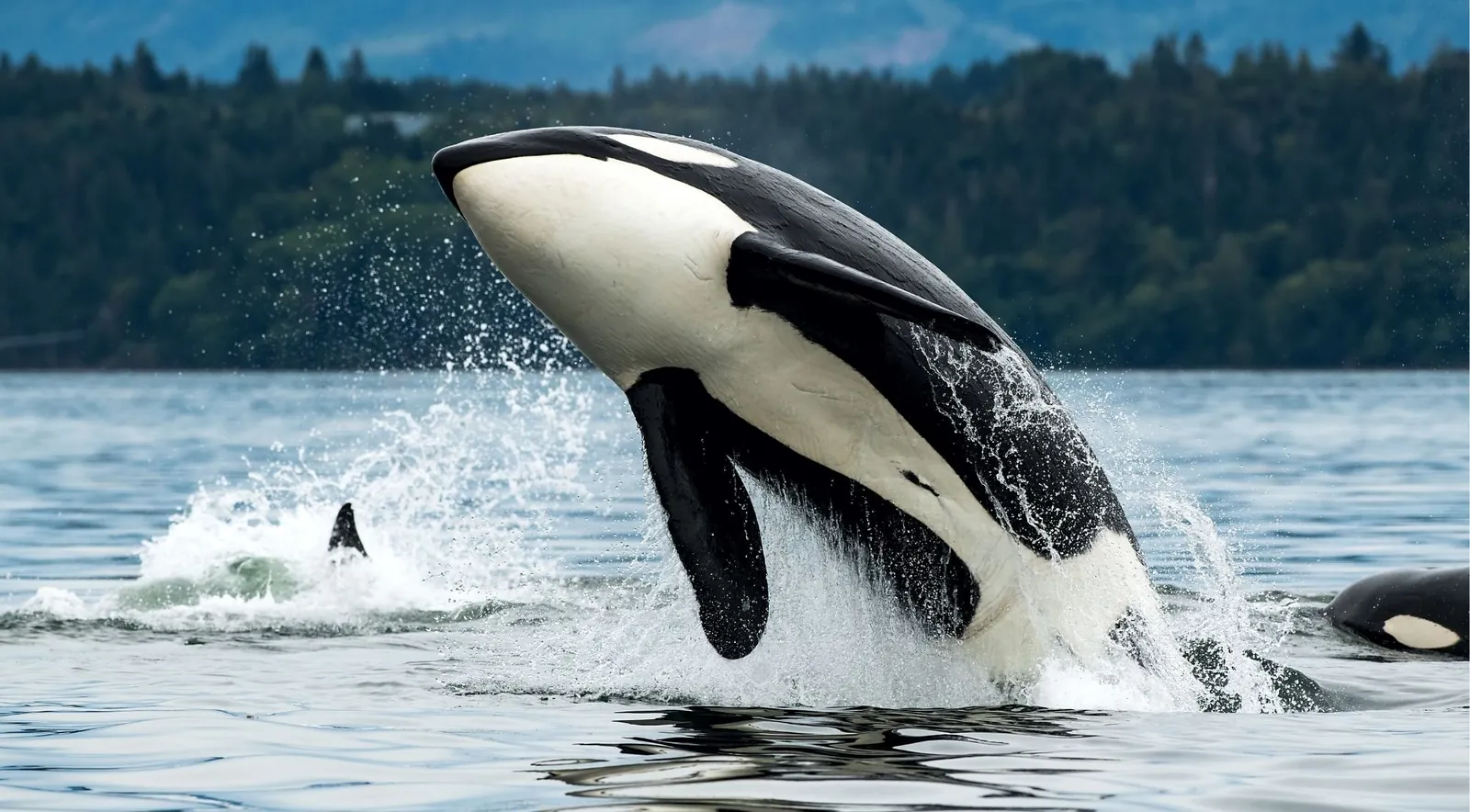
The short version
- Most reliable orca: the Bigg's (transient) killer whale — in the Salish Sea almost every day of the year. A boat tour from Steveston, Granville Island or Victoria is your best bet (90–98% peak-season sighting rates).
- Best free shore lookouts: East Point on Saturna Island and Lime Kiln Point on San Juan Island, both on the Haro Strait / Boundary Pass corridor.
- For resident orcas: Telegraph Cove / Johnstone Strait on northern Vancouver Island is world-class in July–September.
- Peak season: roughly May–October, with morning departures offering the calmest seas.
The Two (and a Half) Orca Populations
Bigg's (transient) killer whales are mammal-hunters — they eat seals, sea lions, porpoises and dolphins — and travel in small, stealthy groups of roughly 3–7 animals. Their population is booming: around 380 individuals in coastal BC waters, sighted on 342 days in 2025. This is the orca you're most likely to see.
Southern Resident killer whales (J, K and L pods) are fish-eaters that depend almost entirely on Chinook salmon. They are critically endangered, with just 74 individuals as of the July 2025 Center for Whale Research census (27 in J pod, 14 in K pod, 33 in L pod). Tours do not chase them.
Northern Resident killer whales are a separate, larger fish-eating population of roughly 300+ animals occupying the northern half of Vancouver Island, returning each summer to Johnstone Strait and the Broughton Archipelago.
Top Specific Locations for Orcas
Haro Strait (San Juan Island / Lime Kiln Point). This deep, salmon-rich channel forms the Canada–US border west of San Juan Island and is the classic orca corridor. The seafloor drops to 900+ feet just yards offshore at Lime Kiln Point, letting orcas hunt extremely close to land. Best May–September.
Boundary Pass & the Southern Gulf Islands (East Point, Saturna Island). Directly on the route Southern Residents historically used between the open Pacific and the Fraser River mouth. Powerful tidal upwellings concentrate fish, making it one of the best land-based orca lookouts in Canada. Best May–November.
Active Pass (between Galiano and Mayne Islands). A narrow, tidally turbulent channel — crossed constantly by BC Ferries — that is designated critical habitat and a recognized feeding and travel route. Bellhouse Park on Galiano gives a free shore vantage.
Strait of Georgia / Gulf Islands (the Vancouver day-tour zone). Tours from Steveston and Granville Island work the Strait of Georgia and Gulf Islands, often ranging toward the San Juan Islands depending on where the day's whales are.
Steveston / Fraser River mouth. The Fraser plume creates a rich feeding zone, and Steveston is the closest major departure point to the Gulf Islands grounds — about 35 minutes south of downtown Vancouver.
Johnstone Strait & the Broughton Archipelago (Telegraph Cove). The 110-km Johnstone Strait — dubbed the "orca highway" — is the summer home of the Northern Residents and one of the best places on Earth to see orcas, with around 300 returning each summer. Best mid-July to mid-September. It's a long drive or flight from Vancouver, so it's a dedicated trip rather than a day out from the city.
Vancouver vs. Victoria vs. Northern Vancouver Island
Vancouver (Steveston / Granville Island). Most convenient if you're based in the city. Tours run 3–5 hours through the Gulf Islands and Strait of Georgia, and you'll almost certainly see Bigg's orcas and humpbacks. No ferry or extra travel, frequent departures and strong success rates.
Victoria (Inner Harbour / Fisherman's Wharf). Victoria sits closest to the richest orca grounds — Haro Strait, the Gulf and San Juan Islands, and Juan de Fuca — with the densest concentration of operators. The trade-off is getting to Vancouver Island first by ferry or floatplane.
Northern Vancouver Island (Telegraph Cove / Johnstone Strait). The premium, immersive choice and the best place for resident orcas and kayaking with whales — world-famous, with fewer boats — but remote, with a season concentrated July–September.
Campbell River (Discovery Passage). Another gateway to the same Northern Resident and Bigg's waters, Campbell River on eastern Vancouver Island runs longer 4–6 hour trips deeper into Johnstone Strait and the Discovery Islands — a strong alternative to Telegraph Cove, with excellent humpback and orca odds in summer.
Shore-Based (Free) Orca Watching
- East Point, Saturna Island (Gulf Islands National Park Reserve) — arguably Canada's best land-based orca lookout; both ecotypes pass close to the rocks. Reachable by BC Ferries or floatplane.
- Lime Kiln Point State Park ("Whale Watch Park"), San Juan Island, WA — one of the best shore orca-viewing spots in the world. Requires a US trip and a Discover Pass.
- Bellhouse Park, Galiano Island — overlooks Active Pass.
- East Sooke Regional Park (Aylard Farm / Creyke Point), near Victoria — free, rugged coastal lookouts over Juan de Fuca.
- Telegraph Cove boardwalk and the Blinkhorn Trail viewpoint — a chance to spot Johnstone Strait orcas from land.
Boat Tours: Zodiac vs. Covered Vessel
Zodiac (open or semi-covered RHIB). Fast, thrilling and close to the water; passengers wear full flotation / mustang suits. Best for thrill-seekers and photographers, usually with a minimum age (often 8+).
Covered vessel / catamaran. Heated cabins, washrooms and a stable ride — good for families, seniors and anyone prone to seasickness.
Famous Orcas and Pods
- Tahlequah (J35), a Southern Resident in J pod, drew worldwide attention in 2018 when she carried her dead calf for 17 days across 1,000 miles, and made headlines again in early 2025 after losing calf J61.
- Granny (J2), estimated to have been born around 1911, was the long-time matriarch of J pod — last seen October 12, 2016 and declared deceased in January 2017.
- Among Bigg's, T137A "Jack," T123A "Stanley" (named after Stanley Park, recognizable by his "overbite") and the T049A "Nan" matriline are local celebrities.
Tips Specific to Orca Watching
- Scan the horizon, not the water next to the boat. Look for the blow first, then the tall black dorsal fin — adult male fins can reach about 6 feet.
- Orcas travel in pods — if you see one fin, look for more nearby.
- Watch for behaviour: breaching, spy-hopping, tail-slapping and pectoral-fin slapping. Bigg's on a hunt spread out and surface erratically; a sudden flurry of gulls can signal a kill.
- Photography: use a fast shutter speed, keep both eyes open, shoot in burst mode and bring spare batteries.
Current Regulations (2026)
- Vessels must stay 1,000 metres from Southern Resident killer whales in southern BC waters, under the 2026 Interim Order in force June 1, 2026 through May 31, 2027.
- Vessels must stay 200 metres from all other killer whales in Pacific Canadian waters.
- Vessel Restricted Zones are in effect June 1–November 30 off Saturna and Pender Islands.
- Penalties for non-compliance can reach up to $250,000, and drones may not be flown near whales without a permit.